Showing posts with label Early Lighting. Show all posts

Sunday, July 06, 2014

Insert Whitty Title Here

I don't know how people on other blogs manage to come up with all sorts of witty and interesting titles for their posts. I suck at it, and usually don't even try, but I didn't want to call this "Another Boring Update".

As promised, here are the two completed antique grates. One is original to the house (the one in the green living room), and the other identical one was installed to replace the large and poorly located floor grate next to the front door.

If you missed it, and wanted to see how I did that, go see these posts (in this order):
http://my1923foursquare.blogspot.ca/2013/01/secret-project-revealed.html
http://my1923foursquare.blogspot.ca/2013/01/office-floor-new-look-for-2013.html

As I mentioned a few posts ago, I had one missing thumb latch from my original grate, so I had a new copy cast in brass. I had paid 50$ for the second (and complete) grate, and unfortunately, it cost 45$ just for the casting. I could have just bought an entire new grate for an extra 5$, but I would have needed to travel out of town to go get it, and I hadn't gotten a quote for the casting, so I didn't think it was going to be that much.


Here's the final product. Grate closed:


Grate open:


Office grate:


In other news, I decided to spend last night with some lovely antique lighting. I used my two whale oil lamps, paired with old mirrors to double the light.


This prompted me to look for my other whale oil lamp AGAIN. I had another nice clear lamp that I've had packed away, and I couldn't find it. I looked for it on 3 or 4 occasions over the past month or so, and I finally found it this afternoon.

I wasn't happy with how I found it though...


Broken in half.


I actually discovered that the lamp was already broken here, and previously repaired. There was a thin layer of clear adhesive, and I spent about 30 minutes scraping it off and cleaning the joint. I plan to re-repair the lamp with Hxtal, which is a specialty glass adhesive used by museums. It's very expensive, but it's supposed to make an incredibly strong repair, and be crystal clear. I've been meaning to buy some to repair a broken clock glass (hand painted) from the 1840s, so this is another excuse for me to buy some.

This fine lamp also has a completely ruined original pewter collar, which I will need to replace, along with a burner. Unfortunately it's not a standard size, which will make my restoration job incredibly difficult. The lamp is from the 1830s or 40s.

Friday, May 02, 2014

Whale Oil Lamps

It's no secret that I love antiques. I tend to buy mainly small furniture, tools, and clocks (too many to count), but I also really love antique lamps.

I have quite a few oil lamps, some found at yard sales and thrift stores, while others were bought online.

My favourites are whale oil lamps.

If you're not familiar with these, they were one of the first "fancy" oil lamps created for home illumination. Before they came along, indoor lighting was done mainly with candles, a fireplace, and betty lamps (lard/fat lamps). The latter being crudely fashioned from sheet metal or cast iron.

I should stress that at the time when they came along (1820s to the early 1840s) kerosene lamps had not been invented yet.

The original fuel for these new lamps was refined oil from the sperm whale. The oil was very expensive to buy, but produced a beautiful and brilliant light. One whale oil lamp produced twice as much light as a regular candle, and the lamps were also a bit of a status symbol.

The majority of these lamps are made from leaded glass or flint glass (aka crystal), which gives a bit of a greyish quality to the glass. The lead content makes them more brilliant and also easier to cut and polish. They are also more fragile, and the bases are very prone to chipping (both my lamps shown below have chipped bases). It is not uncommon to find lamps that have been ground-down and re-polished on the base, or that have had chips repaired.

Some early examples have hand blown fonts (often in the shape of a light bulb) while others have cut and polished fonts, or feature acid etched decorations, usually paired with a cast (fancy) base connected with glass "wafers" in the centre. The presence of wafers in the centre is usually a good indicator of an original lamp since reproductions are usually cast from moulds and will not be made in 2 pieces.

These are a few examples of some beautiful (and pricey) examples:


Note the slightly uneven wafers in between the hand blown tops and cast bases:


It is extremely common to find whale oil lamps with later "fluid lamp" burners. These burners have longer tapered pipes and are meant to burn a volatile (and potentially explosive) mixture of turpentine and alcohol known as "burning fluid". Burning fluid was a cheaper alternative to whale oil, but it was critical to use the correct burners. Whale oil burners have short and stubby tubes that descend deep into the font (to help draw down the heat and soften the whale oil). Burning fluid, when used with whale oil burners, often caused catastrophic explosions, since the correct burners operate with the pipes extended far away from the highly flammable fuel.

Fluid burners usually also have cute little caps and chains to keep the fluid from evaporating when the lamp is not in use.


Perfect examples with no chips or breaks can cost a small fortune (several hundred dollars), with matched pairs fetching more than individual lamps, but there are still bargains out there. I was very lucky to snatch this matched pair for a very low price since they were missing the original burners, and had chipped bases (which I don't mind).

Here are my matched pair of lamps. You will note that my lamps have the same cast base as the example above. Aside from this original pair from the early 1800s, I also have 2 reproduction whale oil lamps, and one other original one (missing the burner - which is an odd size).


I shot a small video for YouTube this evening showing the use/operation/lighting of whale oil lamps, since the web seems to have a very limited resource showcasing these wonderful lamps. Enjoy!

Saturday, November 02, 2013

Living Room Light Fixture Update

I happened to find a set of 5 reproduction glass shades that were dirt cheap (50 cents a piece), and I was originally just going to save them as spares, but instead, I ended up swapping the shades on the living room light fixture.

I went from this:


To this:


I was never that crazy for the shades that came with the fixture (and are slightly mismatched). The only thing I prefer about the old shades is that they're genuine antiques, as opposed to these newer shades. I do, however, prefer the shape of the new ones. They seem to suit the shape of the chandelier better.


I'd say it was 2.50$ well spent.

Sunday, August 18, 2013

Surprise Project Revealed - Staircase Ceiling Done & Light Fixture!

I vaguely hinted at this project "wanting to get the restored light fixture installed soon" but I didn't expect that I'd finish this project so soon.

My boss let me borrow his folding ladder, so this helped quite a bit. I thought I could get the ladder to fold in a different configuration, but it wasn't working out, so I ended up using it in combination with a chair and a 2x4 "bridge".

These 2 photos are a bit blurry since I wasn't using my tripod.


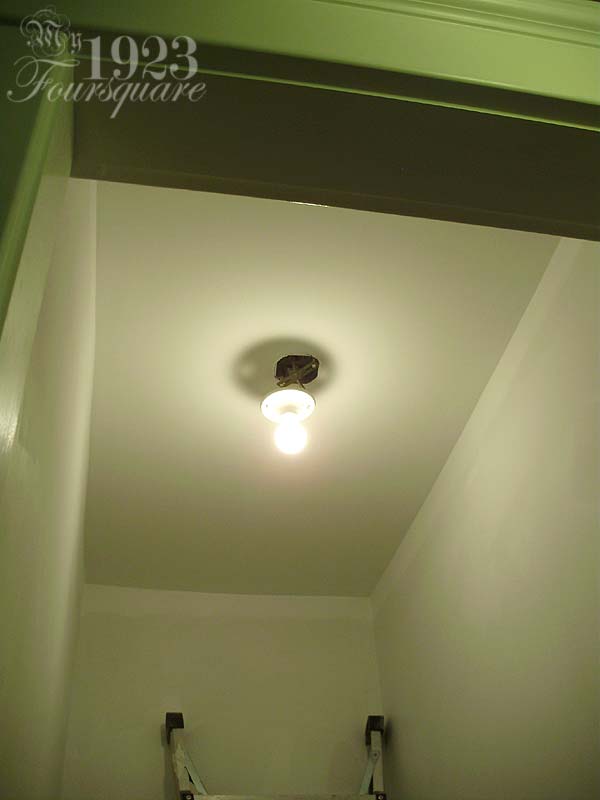
This tiny little ceiling was in AWFUL shape. It had several badly patched screws, defects, and a horrible seam job on all 4 sides. I normally don't post too many drywall photos, but these will give you an idea of how much patching and sanding I had to do.


Popped screws/nails in the centre 2x4 on the narrow wall:


Round 1:


Note semi-finished door casing (I had done all of it except the top crown since I couldn't get to it.


Casing/crown installed and painted (this was the first coat, but I didn't re-photograph it after). Also note: the hallway always looks green in photos due to the lighting, but it's light brown/taupe.


Round 2 was more mud along the ceiling portion of the drywall tape (didn't photograph this). This was after the ceiling got freshly painted with spot touch-ups in primer, and 2 coats of flat white ceiling paint. What a huge difference!

Also, luckily the electrical here didn't really need any work other than adding another screw to anchor the box more securely.


Restored fixture. This is the best I can do for a "natural lighting" photo since this staircase gets no direct sunlight from any direction.


I was going to go for "40w" CFL bulbs in here, but I've had problems with them in places that get frequent "on/off" situations, like bathroom lights. They seem to burn out quite quickly, and I just didn't seem to want to pay 13$ for 4 bulbs that might not last, so I went with 4 incandescent 25w bulbs. It gives a more historic look, isn't too bright, won't look stupid from below, and will likely last a very long time. They only set me back 2.50$ and I don't think I'll be losing too much in energy savings here either.


View from the bathroom:


View from the main floor looking up.


I couldn't be happier with it. The height is great, and it's just long enough to reach the globes to change the bulbs or clean the shades, and it's far enough away to be well out of the way of your head (at least a foot).

Saturday, May 04, 2013

Astral Lamps

I was actually up early this morning, so that I could walk to a few nearby yard sales (first ones of the year for me!) I only went to 4, but I didn't walk away empty handed.

I actually found these little gems at an unlikely yard sale. I know this guy as "the DVD guy". He's an older guy who goes to yard sales and then re-sells items at his own yard sale. He mainly has a large selection of DVDs, and also antiques (mainly knick-knacks and dishes), but I found the lamps there.

These are older reproduction "Astral" style lamps. I'd guess that they're from the 1930s or 1940s. Around that time there was a revival of older styled items (like electrified versions of whale oil lamps as another example).

They caught my eye because of the cut glass shades, and the pierced brass rim (which would hold drop crystals/prisms). I really love early lighting (oil lamps, whale oil lamps, candle sticks, etc) so I got the pair for 14$.


The bases are marble, and they are fitted with a small turn switch. What's also fun about these, is that they have antique cloth cords and button plugs, but these almost look new (or perhaps the lamps weren't used for most of their lives).


They're in excellent shape. The shades have no chips or cracks. The only drawback is that the prisms are missing, and I know they're still available new as replacements, but unfortunately they're around 5-60$ each and I need 16 of them. I'll keep my eyes out for some used ones, but I may leave them as-is.

I will probably use these on my night stands.

These lamps are made to resemble early oil lamps from the early 1800s, like the ones below.


This is a similar style, but different type of lamp, known as an Argand Lamp. These are usually used in pairs, and some versions have 2 arms (T shape). Argand Lamps date as far back as 1780.

Tuesday, June 19, 2012

Banquet Lamp

My father, over the weekend, gifted me his antique banquet lamp. He's had it for as long as I can remember, and it used to be in the bedroom. It's a rather large and ornate lamp, and the base is made of "Brittania" metal (aka pot metal, white metal, etc) painted to look like brass or gold. It has the original shade and chimney, but it has unfortunately been electrified in a destructive way (meaning it can't really be switched back to oil burning since they drilled a hole in the oil reservoir).

The only other flaw is a chip on the shade at the top.

I'm not sure where I'm going to put it yet, but it will probably end up on an antique dresser in the guest bedroom, or possibly in the living room.


The floral design is hand painted. The main design is large, but there's a small single flower centered on the back as well.